

自动化测试 26.2
使用 Fabric Loader JUnit 写自动化测试的指南。
此页面解释了如何在你的模组中编写自动化测试。有两种方法自动化测试你的模组:使用 Fabric Loader JUnit 进行单元测试,或使用 Minecraft 游戏测试框架进行游戏内测试。
单元测试用于测试你代码中的组件,比如方法和工具类;游戏内测试则启动 Minecraft 客户端与服务端来运行你的测试,适用于测试功能和游玩过程。
单元测试
由于 Minecraft 模组运行依赖于运行时字节码修改工具比如 mixin,仅仅添加并使用 JUnit 一般不会生效。这就是为什么 Fabric 提供了 Fabric Loader JUnit,一个针对 Minecraft 模组进行单元测试的 JUnit 插件。
配置 Fabric Loader JUnit
首先,我们需要将 Fabric Loader JUnit 添加到开发环境。将以下依赖添加到你的 build.gradle:
gradle
testImplementation "net.fabricmc:fabric-loader-junit:${project.loader_version}"然后,我们需要告诉 Gradle 使用 Fabric Loader JUnit 来测试。你可以通过将以下代码添加到 build.gradle 来做到这件事:
gradle
test {
	useJUnitPlatform()
}编写测试
重新加载 Gradle 后,现在就可以编写测试了。
这些测试的编写方式与常规 JUnit 测试相同,如果你想访问任何依赖于注册表的类(例如ItemStack),则需要进行一些额外的设置。如果对 JUnit 比较熟悉,那么可以跳至设置注册表。
设置你的第一个测试类
测试编写于 src/test/java 目录下。
一种命名约定是镜像你正在测试的类的包结构。例如,要测试 src/main/java/com/example/docs/codec/BeanType.java,应在 src/test/java/com/example/docs/codec/BeanTypeTest.java 创建一个类。注意我们是如何将 Test 加入到类名称最后的。这还允许你轻松访问包范围内私有(package-private)的方法和字段。
另一个命名约定是有一个 test 包,例如 src/test/java/com/example/docs/test/codec/BeanTypeTest.java。如果你使用 Java 模块,这可以避免在使用相同包时可能出现的一些问题。
创建测试类后,使用 ⌘/CTRL+N 调出生成菜单。选择测试并开始输入方法名称,通常以 test 开头。完成时请按下 ENTER 键。有关使用 IDE 的更多提示和技巧,请参阅 IDE 提示和技巧。
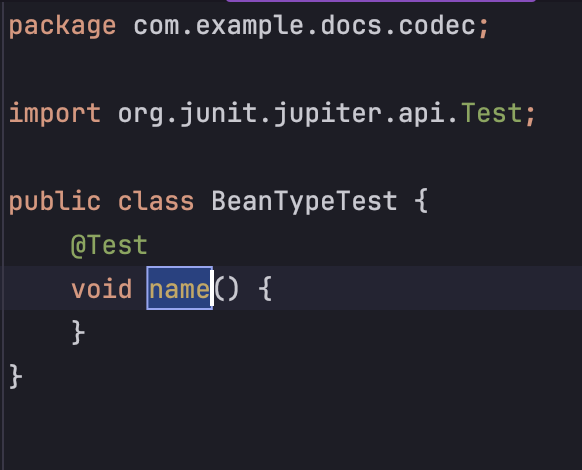
当然,你可以手写方法签名,任何没有参数且返回类型为 void 的实例方法都将被标识为测试方法。你应该以这样结尾:
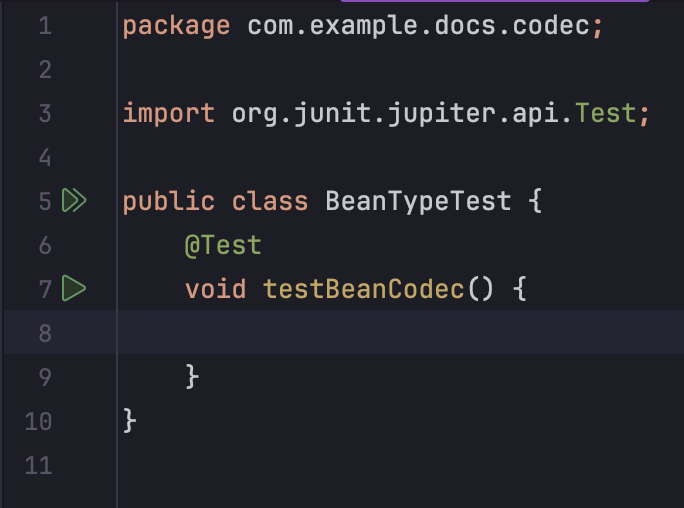
注意侧边栏中的绿色箭头指示——可以简单地点击来运行测试。或者,你的测试将在每次构建时自动运行,包括 GitHub Actions 等 CI 构建。如果你正在使用 GitHub Actions,请不要忘记阅读设置 GitHub Actions。
现在,该编写您的实测代码了。你可以使用 org.junit.jupiter.api.Assertions 断言条件。检查以下测试:
java
public class BeanTypeTest {
	private static final Gson GSON = new GsonBuilder().create();

	@BeforeAll
	static void beforeAll() {
		BeanTypes.register();
	}

	@Test
	void testBeanCodec() {
		StringyBean expectedBean = new StringyBean("This bean is stringy!");
		Bean actualBean = Bean.BEAN_CODEC.parse(JsonOps.INSTANCE, GSON.fromJson("{\"type\":\"example-mod:stringy_bean\",\"stringy_string\":\"This bean is stringy!\"}", JsonObject.class)).getOrThrow();

		Assertions.assertInstanceOf(StringyBean.class, actualBean);
		Assertions.assertEquals(expectedBean.getType(), actualBean.getType());
		Assertions.assertEquals(expectedBean.getStringyString(), ((StringyBean) actualBean).getStringyString());
	}

	@Test
	void testDiamondItemStack() {
		// I know this isn't related to beans, but I need an example :)
		ItemStackTemplate diamondStack = new ItemStackTemplate(Items.DIAMOND, 65);

		Assertions.assertTrue(diamondStack.is(Items.DIAMOND));
		Assertions.assertEquals(65, diamondStack.count());
	}
}有关此代码实际作用的解释,请参阅 Codec。
设置注册表
很好,第一个测试运行了!但是稍等,第二个测试失败了?在日志文件中,我们得到了以下错误。
log
java.lang.ExceptionInInitializerError
	at net.minecraft.item.ItemStack.<clinit>(ItemStack.java:94)
	at com.example.docs.codec.BeanTypeTest.testBeanCodec(BeanTypeTest.java:20)
	at java.base/java.lang.reflect.Method.invoke(Method.java:580)
	at java.base/java.util.ArrayList.forEach(ArrayList.java:1596)
	at java.base/java.util.ArrayList.forEach(ArrayList.java:1596)
Caused by: java.lang.IllegalArgumentException: Not bootstrapped (called from registry ResourceKey[minecraft:root / minecraft:game_event])
	at net.minecraft.Bootstrap.createNotBootstrappedException(Bootstrap.java:118)
	at net.minecraft.Bootstrap.ensureBootstrapped(Bootstrap.java:111)
	at net.minecraft.registry.Registries.create(Registries.java:238)
	at net.minecraft.registry.Registries.create(Registries.java:229)
	at net.minecraft.registry.Registries.<clinit>(Registries.java:139)
	... 5 more

Not bootstrapped (called from registry ResourceKey[minecraft:root / minecraft:game_event])
java.lang.IllegalArgumentException: Not bootstrapped (called from registry ResourceKey[minecraft:root / minecraft:game_event])
	at net.minecraft.Bootstrap.createNotBootstrappedException(Bootstrap.java:118)
	at net.minecraft.Bootstrap.ensureBootstrapped(Bootstrap.java:111)
	at net.minecraft.registry.Registries.create(Registries.java:238)
	at net.minecraft.registry.Registries.create(Registries.java:229)
	at net.minecraft.registry.Registries.<clinit>(Registries.java:139)
	at net.minecraft.item.ItemStack.<clinit>(ItemStack.java:94)
	at com.example.docs.codec.BeanTypeTest.testBeanCodec(BeanTypeTest.java:20)
	at java.base/java.lang.reflect.Method.invoke(Method.java:580)
	at java.base/java.util.ArrayList.forEach(ArrayList.java:1596)
at java.base/java.util.ArrayList.forEach(ArrayList.java:1596)这是因为我们正在尝试访问注册表或依赖于注册表的类(或者,在极少数情况下,依赖于其他 Minecraft 类,如 SharedConstants),但 Minecraft 尚未初始化。我们只需要初始化一下就能使注册表生效。在你的 beforeAll 函数前简单地加入以下代码。
java
SharedConstants.tryDetectVersion();
Bootstrap.bootStrap();配置 GitHub Actions
INFO
本节假设您正在使用包含在示例模组和模组模板中的标准 GitHub Action 工作流。
你的测试现在将在每个构建上运行,包括由 GitHub Actions 等 CI 提供商构建的构建。但是如果构建失败呢?需要将日志作为工件上传,这样就可以查看测试报告了。
将下列文本添加进 .github/workflows/build.yaml 文件中 ./gradlew build 步骤的下方。
yaml
- name: Store reports
  if: failure()
  uses: actions/upload-artifact@v4
  with:
    name: reports
    path: |
      **/build/reports/
**/build/test-results/游戏测试
Minecraft 提供了用于测试服务器端功能的游戏测试框架。 Fabric 还提供客户端游戏测试来测试客户端功能,类似于端到端测试。
使用 Fabric Loom 设置游戏测试
服务器和客户端游戏测试都可以手动设置或使用 Fabric Loom 设置。本指南将使用 Loom。
要将游戏测试添加到你的模组,请将以下内容添加到你的 build.gradle:
gradle
fabricApi {
	configureTests {
		createSourceSet = true
		modId = "example-mod-test-${project.name}"
		enableGameTests = true // Default is true
		enableClientGameTests = true // Default is true
		eula = true // By setting this to true, you agree to the Minecraft EULA.
	}
}要查看所有可用选项,请参阅 Loom 测试文档。
设置游戏测试目录
INFO
如果你启用了 createSourceSet,则仅需要此部分,推荐这样做。当然,你也可以自己编写 Gradle 代码,但你需要自行承担所有风险。
如果你像上面的示例一样启用了 createSourceSet,那么你的游戏测试将位于单独的源集中,并带有单独的 fabric.mod.json。模块名称默认为 gametest。在 src/gametest/resources/ 中创建一个新的 fabric.mod.json,如下所示:
json
{
  "schemaVersion": 1,
  "id": "example-mod-test",
  "version": "1.0.0",
  "name": "Example mod",
  "icon": "assets/example-mod/icon.png",
  "environment": "*",
  "entrypoints": {
    "fabric-gametest": [
      "com.example.docs.ExampleModGameTest",
      "com.example.docs.entity.EntityAttributesGameTest"
    ],
    "fabric-client-gametest": ["com.example.docs.ExampleModClientGameTest"]
  }
}请注意,此 fabric.mod.json 需要在 src/gametest/java/com/example/docs/ExampleModGameTest 进行服务器游戏测试,并在 src/gametest/java/com/example/docs/ExampleModClientGameTest 进行客户端游戏测试。
编写游戏测试
你现在可以在 src/gametest/java 目录中创建服务器和客户端游戏测试。以下是每个示例的基本示例:
java
package com.example.docs;

import java.lang.reflect.Method;

import net.minecraft.gametest.framework.GameTestHelper;
import net.minecraft.world.level.block.Blocks;

import net.fabricmc.fabric.api.gametest.v1.CustomTestMethodInvoker;
import net.fabricmc.fabric.api.gametest.v1.GameTest;

public class ExampleModGameTest implements CustomTestMethodInvoker {
	@GameTest
	public void test(GameTestHelper context) {
		context.assertBlockPresent(Blocks.AIR, 0, 0, 0);
		context.succeed();
	}

	@Override
	public void invokeTestMethod(GameTestHelper context, Method method) throws ReflectiveOperationException {
		context.setBlock(0, 0, 0, Blocks.AIR);
		method.invoke(this, context);
	}
}java
package com.example.docs;

import net.fabricmc.fabric.api.client.gametest.v1.FabricClientGameTest;
import net.fabricmc.fabric.api.client.gametest.v1.context.ClientGameTestContext;
import net.fabricmc.fabric.api.client.gametest.v1.context.TestSingleplayerContext;

@SuppressWarnings("UnstableApiUsage")
public class ExampleModClientGameTest implements FabricClientGameTest {
	@Override
	public void runTest(ClientGameTestContext context) {
		try (TestSingleplayerContext singleplayer = context.worldBuilder().create()) {
			singleplayer.getClientLevel().waitForChunksRender();
			context.takeScreenshot("example-mod-singleplayer-test");
		}
	}
}有关详细信息,请参阅 Fabric API 中的相应 Javadoc。
运行游戏测试
服务器游戏测试将通过 Gradle 任务 build 自动运行。你可以使用 Gradle 任务 runClientGameTest 运行客户端游戏测试。
在 GitHub Actions 上运行游戏测试
使用 build 的现有 GitHub Action 工作流将自动运行服务器游戏测试。要使用 GitHub Actions 运行客户端游戏测试,请将以下代码片段添加到 build.gradle 文件,并将以下作业添加到你的工作流。 Gradle 代码片段将使用 Loom 的生产运行任务运行客户端游戏测试,该作业将在 CI 中执行生产运行任务。
WARNING
目前,由于网络同步器出现错误,游戏测试可能会在 GitHub Actions 上失败。如果遇到此错误,你可以在生产运行任务声明中将 -Dfabric.client.gametest.disableNetworkSynchronizer=true 添加到 JVM 参数中。
gradle
dependencies {
  productionRuntimeMods "net.fabricmc.fabric-api:fabric-api:${fabricApiVersion}"
}

tasks.register("runProductionClientGameTest", net.fabricmc.loom.task.prod.ClientProductionRunTask) {
	jvmArgs.add("-Dfabric.client.gametest")
	// Whether to use XVFB to run the game, using a virtual framebuffer. This is useful for headless CI environments.
	// Defaults to true only on Linux and when the "CI" environment variable is set.
	// XVFB must be installed, on Debian-based systems you can install it with: `apt install xvfb`
	useXVFB = true
}yaml
client_game_test:
  runs-on: ubuntu-24.04
  steps:
    - uses: actions/checkout@v4
    - uses: actions/setup-java@v4
      with:
        distribution: temurin
        java-version: 25
    - run: ./gradlew runProductionClientGameTest
    - if: always()
      uses: actions/upload-artifact@v4
      with:
        path: build/run/clientGameTest/screenshots